

Female education in India has always lagged behind that of males and the national average. Over time, the government has implemented measures such as “Beti Bachao, Beti Padhao” to improve female literacy. Even after 80 years of independence, female literacy was 65.46%, compared with 82.14% for males. This lagged almost 9% behind the national average.
Although education is an important indicator of women’s empowerment and social development, access to extended schooling remains uneven across India’s districts, reflecting differences in educational infrastructure, socioeconomic conditions and regional development. The recent NFHS-6 (2023-24) data reveal a striking truth about female literacy in India: although female literacy has increased to 73.2% in 2023, only 46.04% of literate females have completed 10 years or more of schooling.
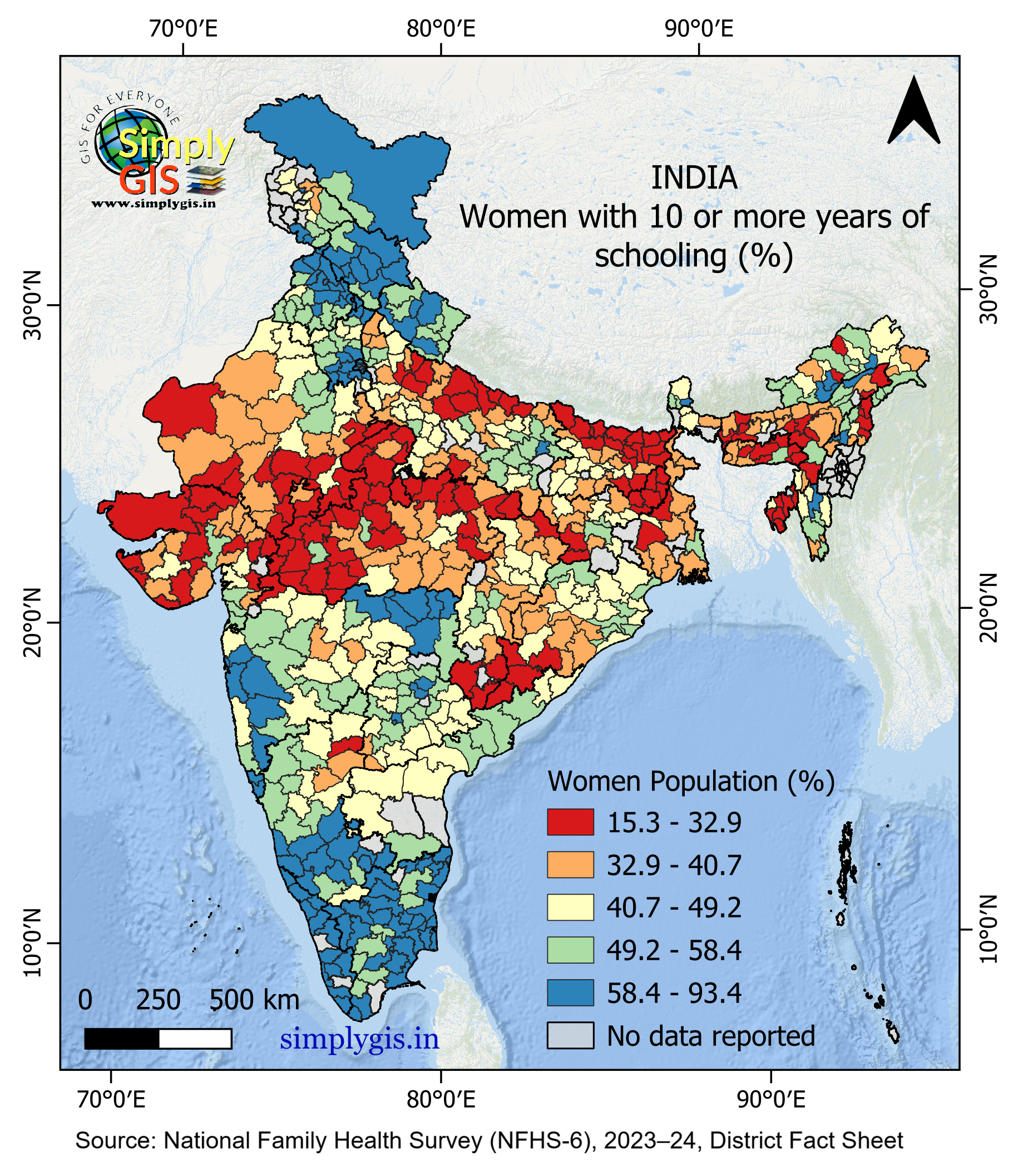
In this Map Story, we mapped the percentage of women with 10 or more years of schooling across 714 districts in India, using the NFHS-6 (2023–24) District Factsheets. The map reveals substantial geographical disparities in women’s educational attainment.
Key Findings
- Kerala Dominates the Top Three: Alappuzha district records the highest share of women with 10 or more years of schooling at 93.4%, followed by Pathanamthitta (93.2%) and Ernakulam (92.4%). All three districts are located in Kerala.
- Central and Northern India Record the Lowest Shares: Jhabua in Madhya Pradesh has the lowest share at just 15.3%, followed by Shrawasti in Uttar Pradesh (15.4%) and Alirajpur in Madhya Pradesh (17.6%).
- A Significant Educational Divide: The difference between the highest and lowest districts is 78.1 percentage points. While 123 districts report 60% or higher, 93 districts have less than 30% of women with 10 or more years of schooling.
- Kerala Leads Among States: Kerala records the highest average district-level share at 86.0%, followed by Puducherry (74.9%), Chandigarh (70.1%) and Himachal Pradesh (69.5%). These figures highlight the relatively stronger performance of southern and certain northern hill regions.
- Statewise Disparities Remain Pronounced: Tripura records the lowest average district-level share at 31.6%, followed by Madhya Pradesh (31.9%), Meghalaya (33.0%) and Bihar (33.4%). The average across all 714 districts is approximately 46.0%.
- Only 123 of 740 districts have 60% or higher female educational attainment, showing a wider gap in district-wise female literacy. The gap between the highest and lowest performing districts is 78.1 percentage points.
Why Does This Matter?
Women’s educational attainment is closely associated with economic opportunities, health awareness, social mobility and participation in decision-making. Completing 10 or more years of schooling can expand women’s opportunities for further education, skill development and employment.
The geographical disparities highlighted in this map reveal that progress in women’s education has not been uniform across India. The central and northern Indian districts have performed poorly in promoting female education. As a result, most districts in this region have a low share of females completing 10 years of schooling and opting for higher education.
Districts with lower educational attainment require greater attention towards improving access to secondary education, reducing school dropouts and addressing socioeconomic barriers that restrict girls’ educational opportunities.
Understanding these spatial inequalities can help policymakers identify priority regions and strengthen initiatives aimed at achieving gender equality and inclusive educational development.
In the SimplyGIS Map Stories series, we uncover what data tells us — through the perspective of geography and spatial thinking.
Leave a Reply